Saturday, February 15, 2014

Bucharest. Current Events. Romania Draft Legislation. Dolphin Personhood. Recognizing Dolphins as Non-Human Persons. Draft Legislation.

What human qualities, if found in a creature not human, shall afford that creature the rights and protections of a human. Remus Cernea, legislator in Romania, the Black Sea area, city of Constanta, has appropriate ideas. He would afford to dolphins the same rights as people. Personhood, so that killing a dolphin, for example, would be subject to a murder analysis.  Would it be reciprocal? For another day.  For now, whether this effort succeeds is not the issue.  The issue is the effect of raising how we exploit creatures to the level of legislative discussion that is more pivotal to the cause of how we coexist with our fellow planet earth residents over time. See http://uk.reuters.com/article/2014/02/14/oukoe-uk-romania-dolphins-idUKBREA1D1J920140214/.  For Mr. Cernea's Statement, Remus Cernea, and text of proposed legislation at the Draft Law, http://voxpublica.realitatea.net/politica-societate/draft-law-for-recognizing-dolphins-as-non-human-persons-102731.html

This is news in any nation that eats, uses, keeps animals. Dogs have long been excluded from humanitarian considerations in Romania, for example, even when pets. I recall in Romania the hundreds of stray dogs, all breeds, wandering alone or in packs even in unpopulated areas. Dogs forced loose by laws that forbade residents forced out of their homes for governmental purposes from taking their pets with them.  We reminded ourselves, tempted to pet, to talk softly, to coo, hello puppy, to keep hands in pockets, eyes ahead. Our impression was that Romania did not care, or was not allowed to care, about its animals. See http://www.occupyforanimals.org/romania---on-the-greatest-animal-genocide-in-european-history-government-initiated-anarchy-violations-of-human-rights-and-children-rights.html

1. So what is changing? Thinking. Thinking as to dolphins, if not dogs. Any nation can boast a politician, a lawmaker, with ground-breaking causes, but this cause should be spread.

Romanians are accustomed to Michael the Brave, who in the the tumultuous 16th C ff, managed to unite disparate interests with Polish, Hungarian, Transylvanian groups at each other. No quarter given to those subject to slaughter. He then lost, with betrayals, brutality ensued, Michael returned, prevailed but was assassinated, see Zsigmond Bathori, ,Michael the Brave, and Giorgio Basta article at http://mek.oszk.hu/03400/03407/html/118.html. Scroll down to 1-753.   It is time for Remus the Brave.  Is that so? Or too melodramatic?


For Remus Cernea, imagine the interests that will rally against his vision. May he, as we say, stay strong and perhaps America can follow.

2. Then ask:  On what ground do humans exploit, dominate, use fellow creatures. Because we can?  Because our religion (whose?) translates taking dominion to domination and not leading gently as a god?  See meaning of dominion, from old texts, at Vetting Roots, http://martinlutherstove.blogspot.com/2009/04/what-do-you-do-i-create-tumors.html?q=dominion.  Lead gently, as a god.

3.  Here, Cernea cites the dolphins' high intelligence, relationships within the pod, with other creatures, personality, but all that is only a start.  With equality of right to a life, even if environmentally different, and without ten digits up and down, killing would be subject to the same analyses as murder. The Black Sea rejoices.

Japan is recently in the news for its corralling of dolphins into a killing bay, slaughter of those who cannot escape.  Is it really just a matter of culture, and such deaths not to be reviewed by anyone not of that culture.

4.  How does the draft law look?  This cannot be subject to copyright, so here it is:  Let the Romanian legislature address all issues with clarity and vision. And go to the site and order a T-shirt. http://voxpublica.realitatea.net/politica-societate/draft-law-for-recognizing-dolphins-as-non-human-persons-102731.html


Draft law for recognizing dolphins as non-human persons


Art.1 All species of dolphins enjoy special protection on the territory of Romania, each individual of this species being considered to be a non-human person.

Art. 2 The hereby law defines a non-human person any being that does not belong to the human species, yet posses a developed intelligence, the capacity to form complex social relations, and is the bearer of the following rights:

1. Right to life

2. Right to bodily integrity, and to be free from any acts of cruelty

3. Right to free movement in their own natural environment, not to be captured or hold in captivity with other purposes other than to be offered medical assistance or to be protected from an impending danger.

4. Right to be protected in the own living natural environment, and not to be separated from the group or family he or she belongs.

Art. 3 Any violation of the rights of non-human persons is forbidden and shall be prosecuted with penalties that are equivalent with those stipulated in the Penal Code for violation of similar rights of human persons.

Art. 4 (1) Any current activity involving holding dolphins in captivity and/or using them in various entertaining facilities will cease in no longer than 12 months from the adoption of the hereby law.

(2) During this 12 month period, all dolphins that are considered fit for reintroduction by the specialists will be released into their natural environment populated by the same species.

(3) The dolphins that do not meet criteria for reintroduction in their natural environment will be placed in specialized care for the rest of their lives, and will no longer be used for entertainment purposes on any other purposes that will contravene the status of non-human persons.

Sunday, January 05, 2014

Bucharest - Caravanserai

Romania is not a first thought when the old Silk Routes are mentioned.  Still, it was an important stopping point, a gateway into Europe.  Bucharest boasts a fine caravanserai, now offering a restaurant both in the inner courtyard, and in shelter when needed.  The architecture of these structures has remained constant over country boundaries, see AramcoWorld magazine, at http://www.saudiaramcoworld.com/issue/201104/.  The large square design, two stories on the outer walls, large usually single gate entry, tall and wide to accommodate loaded camels, a well, areas for a mosque, rooms all around, and accommodations for royal travelers as well as those on pilgrimage.
.
These took money and organization to sustain:  unending need for fresh straw, filled ewers of liquids, even wines for the European trader heading east?  There would be a scribe at the entry, recording your identity, your goods, your route, how many livestock.

The idea dates, probably, from the 5th Century BC, although there are references in Middle Eastern tales, such as Gilgamesh, to a traveler finding accommodation, an inn, 3000 BCE.  Inns, rather ramshackle, called "pandochions" accepted all comers as well, and the Good Samaritan of Bible Story, left the wounded traveler at one of those.  Then came a more refined Arabic "funduq".

In Romania today, there are the spaced hostels, pensions, the "cazare" everywhere (see http://www.romaniacazare.com/); and hotelier complexes that recall the huge enterprises of the old days.

 History of Romania's invaders, influences ethnic groups, see http://romaniaandmoldova.com/romania/

Wednesday, January 01, 2014

Bucharest - Ghencea Military Cemetery (Ceaucesu); Museum of the Romanian Peasant; Mogosoia Palace (Lenin)

Bucharest
Ghencea Military Cemetery

We save the capital city for the end of the trip. We aim right out of the airport into the great beyond, wherever that is.  Then, we are not rushed on our way back; or, if we are, it is easier to come back to a major city if we can. City traffic upon first landing is not a good introduction to any country.  Get out of it.

Bucharest is a cosmopolitan city, see http://www.escapeartist.com/efam/63/Travel_To_Romania.

1.  Propellers as markers. Romania honors its war dead in unique ways.

For the air force, those who served are buried with a propeller instead of a headstone.

Ghencea Military Cemetery, Propeller Grave Markers, Bucharest, Romania


The custom of propellers marking graves of pilots is found elsewhere in Romania. For locating well-known graves, go online.  Visit Find A Grave, at http://www.findagrave.com/php/famous.php?page=country&FScountryid=6

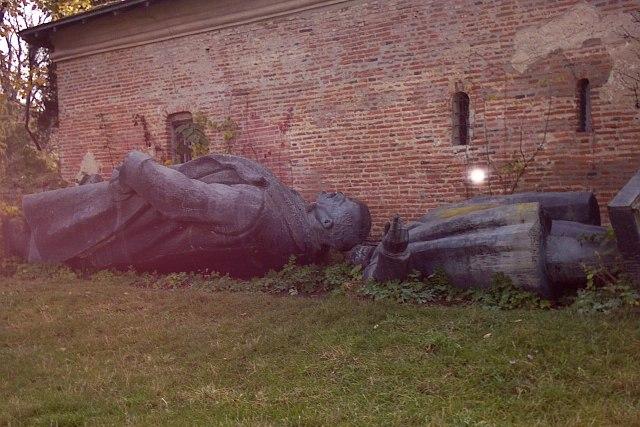
2.  Others who died in the political realm are not so revered, at least in public.  See Lenin statue, toppled, Mogosoaia Palace, near Bucharest.  Lenin's statue is discarded behind the kitchens at Mogosoaia Palace outside Bucharest.

At the Communist Exhibition at the Museum of the Romanian Peasant in Bucharest, however, there is a lower level, creep down in search of the Ladies, and find reverential exhibits, complete with altars, for Lenin and the Ceaucescu, and others.

3.  Nicolai Ceaucescu is buried here, but at the civil side of the cemetery.

Grave, Nicolai Ceaucescu, Ghencea Civil Cemetery, Bucharest, Romania


The Ceaucescus are buried separately at the Ghencea Civil Cemetery in Bucharest, but are some aisles apart.

We looked for a long time before finding either grave, and were carefully watched by guards.

I believe the concern was simple vandalism, and we were not hindered in any way as we looked. Nonetheless, we were watched, watched. Guns ready.
We are not used to that. All we wanted was a look, and a picture. Got them. Got out.

There are tributes on the graves. Candles, objects, even a beer bottle.

Friday, November 15, 2013

Bucharest area. Current Events: Buzescu and Roma, Tsigani, Gypsies


We found several towns where the Roma arriving for an evening's entertainment, perhaps a casino, as in Sighisoara, were in limousines, in beautiful, lavish clothing.  Here, however, is the first article we found affirming that population's presence elsewhere:  National Geographic, September 2012.  Buzescu is south of Bucharest. We did not get there. Is it instead Buzescu Sidonia, near Pitest; or Buzescu HM, farther south from Pitest.

Of special interest is nomenclature.  We understand that "Gypsy" is often seen as derogatory, with a cultural preference for "Roma" instead.  Yet, both may well be needed for more direct communication with those of us on the outside, who are not familiar with Roma as different from Rome, etc. 

Here, we learn that some Roma in Buzescu, Romania, prefer to be called Gypsies or Tsigani.   

Sunday, November 03, 2013

Lake Snagov. Quiet Resort; Development Pending?.

Vlad Tepes (Vlad III Tepes) Burial, or to what extent, on island in Lake Snagov
 
Lake Snagov, Romania. Dockside view, from Complex Astoria resort.


 Snagov is not only a resort area, but also the lake where Vlad's burial on an island monastery, is located, so they say. Fine estates line parts of the shore. As you are rowed out to the island and the monastery, you will also see Ceaucescu's palace, and isolated rocking boats of fishermen, and so quiet.  Visit fast. Development coming.

Tuesday, July 24, 2012

Lake Snagov area and Roma. Literature, Politics

Awareness of minority issues.
Obvious poverty among Roma. 
Amelioration route:  less clear.

1.  Lake Snagov area and Roma.

 There are Roma villages up the dirt roads. Taking out a camera seemed rude, turning people into objects, so we took none in the actual villages. The Roma villages we drove through were stark in their poverty.  Villages sometimes were of light-skinned people, peasants; others were the darker-skinned Rom or Gypsy, but in some cases we could not differentiate. The most isolated villages appeared Rom.  Along the road: old women bent double under firewood, gaunt faces in doorways. We could not be sure at that early time in our visit.  Everyone was helpful, pointed the way.  See FN 1

  • There were no other cars out there in the country where we were, dirt and dust, dirt houses, dirt everywhere, no amenities, even so close to Bucharest. There were deep ruts from the wagon wheels, and horses. Horse carts. That has probably changed by now, with the funding coming in from the EU membership. Has it?

2.  Literature and Roma

Colum McCann wrote a novel, Zoli, in 2007 and based roughly on the life of a Slovakian Roma poet, Branislawa Wajs, see Gypsies, Roma, Romani, and Zoli  He followed it with a current events opinion Gypsies Put Europe To The Test: The Roma of Romania and Bulgaria, at the International Herald Tribune.  A trip to Romania means daily contact with the larger Gypsy or Roma issue, and unanswered questions about what can help the poverty without destroying the culture, and can or will the European Union and other Roma places (the US) tolerate difference  - http://www.iht.com/articles/2007/01/10/opinion/edmcCann.php.

The issue is how Romania, Bulgaria, and other countries regarding the European Union, will deal with their minority populations.

3.  Awareness.  Photo gallery of Roma, done by Leafpile - http://www.leafpile.com/TravelLog/Romania/Roma/Roma.htm.  A problem with photography is it must be paid for. Learn that and be prepared. Children will pose, and adults, but then the hands come out, more arrive. It is a culture issue.  Come up with the coins, even a bill, and more arrive.

  • Look past the crowd at the doorways.  There usually is an adult there. Signal no more, the universal palms flat down, and slicing laterally, and glare, even ceremonially add more coins, and then point to the car, act out driving, and usually the adult will call the others back.  We were not comfortable taking pictures of Roma, looks like our over-concern for people's sense of privacy was off base. Do look at these.
  • Further update, on the poor vs. progress. This is 3/3/08: Read the 2001 On the Margins: Roma and Public Services in Romania, Bulgaria, and Macedonia, With a Supplement on Housing in the Czech Republic, by Ina Zoon, Open Society Institute press 2001. See http://www.romadecade.org/egy-cikk.php?hir_id=9686   The report covers denials of health care, lack of adequate housing, and recommendations.

Sunday, June 24, 2012

Lake Snagov, Snagov Monastery - Vlad Tepes island burial? Complex Astoria

Lake Snagov, 
Snagov Monastery, 
Burial, Possible once,  Vlad III Tepes
Complex Astoria

Approach Romania with a view to history that can be corroborated, and history-stories that cannot, but carry weight.  Then find that the parts that cannot be corroborated, take on an independent fictional existence. Enjoy them all, but vet.  With so many images of Vlad III Tepes, Vlad the Impaler, it takes conscious effort to approach his biography with detachment, see Vlad III Tepes, see See http://www.pitt.edu/~slavic/courses/vampires/images/vlad/vlad.html. 

1.  Lake Snagov.  Is, or was, all or part of Vlad III Tepes buried here.  Row out, from the summer hub, Complex Astoria, to find out.  That is the only access.  Early morning is lovely.

.
Lake Snagov, Romania. Row to monastery from Complex Astoria


Complex Astoria is a traditional resort area now, and about 18 miles from Bucharest, and built during the communist era for the elite. It looked like a perfect first destination from the guidebook, but it did not mention that closes well before we were to arrive in the area, in October  There were caretakers about, and others, so we were given a nice room.  See FN 1 


2.  Snagov Monastery:

The only way to get to the island monastery, and the alleged burial place of Vlad;s body (the claim) is by rowboat. Strong young men at Astoria will do the rowing. Leave plenty of time. Transport to the island is by rowboat. Go fast, before all this changes to motor launches and noise. See it at http://www.bootsnall.com/travelstories/europe/nov03vlad.


It was built in the 1300's, see http://felixromania.com/sights/wallachia/snagov/ Bones were found at a doorway and elsewhere here, some human and some elegant fabric, but there can be established no connection to Vlad, and some apparently there also were animal (chicken) bones.  Apparently he is not there any more.  The story tells that he was moved (his body - the head was decapitated during battle) to the outside, by the door, to protect it. Then, when places were dug up to find him, there was no sign -- only chicken or other animal bones.  Was the head taken elsewhere.
.
There are records that he had once been buried in the church.

There was a printing press here in the 1700's, but then the place became disused, then used as a prison, and eventually, renovations began sporadically, up to 1995 or so. 


.
At the small church on the island, it is pay to play.  A priest takes entry tickets to the interior spot in front of the altar where Vlad is said to be buried. See http://www.draculas.info/gallery/picture_of_monastery_of_snagov_vlad_the_impaler_grave-12/  This site looks like a Romanian offering an overview, to be preferred over the tourism sites, see http://dracula-transylvania.blogspot.com/2008/04/snagov-monastery.html/  

The interior is lovely, even if set for tourists. One novel, "The Historian," by Elizabeth Kostova, see http://www.bookbrowse.com/reviews/index.cfm?book_number=1589 focuses at one point on where the head might have gone, then the body, and by whom, and what happened to the parts next. Are all reunitings good things? See and speculate about the stories at http://www.castleofspirits.com/vlad. - Vlad tales.
.
One novel, "The Historian," by Elizabeth Kostova, see http://www.bookbrowse.com/reviews/index.cfm?book_number=1589 focuses at one point on where the head might have gone, then the body, and by whom, and what happened to the parts next. Are all reunitings good things? See and speculate about the stories at http://www.castleofspirits.com/vlad. - Vlad tales.
.

....................................................

FN  1   Complex Astoria
.
Overnight.  This had been a communist resort, still is a resort, see http://mapcarta.com/28166480.  Use your translator at http://www.tourismguide.ro/tgr/complex_astoria_snagov_1778.php.  Beware that it is seasonal. This was October, and just past the tourist season. More at http://www.world66.com/europe/romania/snagovlake. It was already in process of closing until spring completely, and we were the only guests there.  Nervous?  Why.  It's too late to go elsewhere, we don't travel fancy, our backpacks are all we have, and without faith in human nature no travel is worth it anyway.  When the door would not lock, we stuck a chair under the knob as seen on TV.  Done.
.
There are many campsites and chalets at the resort. The main building is a large hotel with atrium, long halls with rooms. Just fine. Back to locks. Check that you know how to work the locks before accepting the room and unpacking. They are not the same as ours. May take several turns. As it turned out, ours would have locked if we just kept turning, and turning.
.
Timing an arrival somewhere:
.
If you find yourself in a place without restaurants or hotels, as here (we finally found the Complex) just stop at the nearest Magazin Mixt - at the nearest crossroads - convenience store - and make a picnic. Sit outside and eat, and just be friendly. Lots of horsecarts, people, children.

FN 2 

Roma in Romania: 
For any candidate in any country for any substantial elected office: what have you done to promote the well-being of the Roma population in your borders? Education? Structures? Jobs? Health?

2.  Snagov Monastery:  The only way to get to the island monastery, and the alleged burial place of Vlad;s body (the claim) is by rowboat. Strong young men at Astoria will do the rowing. Leave plenty of time. Transport to the island is by rowboat. Go fast, before all this changes to motor launches and noise. See it at http://www.bootsnall.com/travelstories/europe/nov03vlad.
.
The Monastery:
 .

.
There is a small church on the island, with a priest taking the entry tickets to the interior spot in front of the altar where Vlad is said to be buried. See http://www.draculas.info/gallery/picture_of_monastery_of_snagov_vlad_the_impaler_grave-12/  This looks like a Romanian offering an overview, to be preferred over the tourism sites, see http://dracula-transylvania.blogspot.com/2008/04/snagov-monastery.html
.
Apparently he is not there any more.  The story tells that he was moved (his body - the head was decapitated during battle) to the outside, by the door, to protect it. Then, when places were dug up to find him, there was no sign -- only chicken or other animal bones.
.
Still, there are records that he had once been buried in the church.
.

Saturday, June 23, 2012

Travel tips. Cash for the Road. Complex Astoria. Dog Precautions; Eating


Precautions.

1.  Take some cash.

Do not assume that there will be ATM's immediately outside the main city where you land.  Use the airport rather than wait.  For more speed, take some cash in the local currency with you, despite the cost of doing that in the US, just in case.  Heading north toward Snagov, we were suddenly beyond urbanity, and there was no immediately visible place and no banks outside Bucharest for
ATM's that we could see.

Cash was vital.  The next largest town, Brasov, of course had ATM's, but we needed our ready cash for eating and spending the first night.

We got to the Snagov area in late afternoon, got ourselves well lost among little, poverty-overwhelmed villages and dirt-rutted roads. When we found the Complex Astoria to spend the night, we found out why the signs were down. It was closed for the season.  They opened a room for us, and luckily we had cash to pay. No credit card option there.\

2.  Pocket your hands. Stray dogs.

Hand safety can be an issue for the careless, walking around.  Ask before being friendly with dogs, and if noone is around, pocket your hands.  There are homeless dogs everywhere, in packs, and by themselves.

Why? We understand that Ceaucescu would not let people take their pets when they were moved wholesale in Bucharest and elsewhere out of neighborhoods that were then razed for big government buildings and boulevards, into high rises.  This is a huge issue, not only for humane treatment of all living, but for public safety.  See http://www.koirienystavat.com/en/dogs-in-romania/.   Puppies, show dogs, all were set loose. Thousands upon thousands are out there now.

These are often identifiable specific breeds, cockers covered in burrs, little doggies, even still.  New parliament buildings were needed.  Was that necessary, to forbid the pets, given the public health and other nuisance now?  By way of update, see http://www.ibtimes.com/romanian-stray-dogs-slaughtered-streets-red-card-romania-spreads-facebook-1505630

We were told to keep our hands in our pockets, so we did. The dogs trot along with you, just don't pet. Others not so friendly. We were told not to experiment.

3.  Food when there are no restaurants

Dinner when there is no dinner.  Magazin Mixt.
.
Magazin Mixt means convenience store. At Lake Snagov, we had a fine meal from a general deli (dried sausage, rolls, cheese), a kind of bodega, at a village. People and especially children came around to stare, but we felt welcome and safe.
.

Sunday, June 10, 2012

Brasov, Bran Castle

Bran Castle is part of the Vlad Tepes collection of sites, in detail at http://romaniaroadwaysvladtepes.blogspot.com/2006/08/bran-castle-brasov-popular-tradition.html.


Bran Castle, a rainy look-back.

Our route:  Airport at Bucharest, head immediately north to Lake Snagov where Vlad Tepes may or may not be buried or have been buried all or in part, see Sinaia and Peles Castle, and then on to Brasov.

Find Bran Castle and the other Vlad Tepes sites in detail and with photos at  Romania Road Ways II, Vlad Tepes, site, at http://romaniaroadwaysvladtepes.blogspot.com/2006/08/bran-castle-brasov-popular-tradition.html. 

We integrate them here as a place holder.  How to see where we went, if we totally separate out Vlad Tepes?

Bran Castle:  obvious from the roadway, go there.

Thursday, June 07, 2012

Brasov: Bran Castle - Popular tradition for Vlad. Not really Vlad.

 Brasov, Bran Castle
This looks "Dracula" but was he ever here? Probably not.
.

1.  Bran Castle, in Brasov, is about 70 miles north of Snagov Lake, where the island monastery claims to hold Vlad remains, or did. Bran is about 87 miles north of Bucharest.  Brasov gets tourists because Bran Castle looks good, is indeed a real and very historic castle, see http://www.draculas.info/travel_transylvania/bran_castle_history_i/, and is not far Bucharest's airport.  It is located in a confluence of trade and military routes, defending against the Ottomans, and became wealthy with customs and other fees and duties.
.
2.  Vlad's armies also attacked Brasov, but that did not relate particularly to Bran Castle. See the Draculas Info site.  The Bran Fortress is pivotal to Romanian history in its own right:  the incursion of Vlad tourists thinking this is pivotal Vlad does the castle a disservice, diminishing interest in real history.
.
.
The guides at the castle will tell you that Vlad was only there as a guest once in a while, if even that, or was imprisoned there. It is lovely, well restored, but tenuous in any significant connection or any connection at all to the historic Vlad Tepes.
.
Tours do hype the factoid that Vlad lived there. But it makes a buck - or lei, or the new leu.  For the claims, see, for example.
A recent TV show (this is an update 2/2/07) showed Bran Castle and the town of Brasov, as one of the walled towns that Vlad used in anchoring his rule, especially against the Ottoman invasion. There was no hint of that when we were there, but we see now that he had other connections to Brasov.  He was arrested near Brasov by Matthias Corvinus; and he later, for other reasons, led an assault on the town and impaled many on a nearby hill.  It was a successful commercial town, with many influential Saxon merchants.  Vlad led an assault on Brasov (no mention of Bran) to break the hold of the Saxons.  Credibility of all the accounts historically is questionable, but they clinched his reputation. See overview account at http://www.ucs.mun.ca/~emiller/vlad.html.

3.  Vlad the Impaler and "Impalement"

Impalement:  this was also a means of "crucifixion", see Crucifixion, history, uses, variations for etymology and more information than you want to know.  The point is that the method was common. Did Vlad do more than most? Probably, or not? Takes more research than merely looking at woodcuts with agendas, making a point.
.
4.  Return of property.
.
I read that the government is giving the castle back to the heirs, so it may or may not remain open as a tourist destination. Vlad or not, it is lovely.
.
5.  Comparing history with legend
.
Some sites do a fine job of comparing the legends with the historical reality, as far as that is known or debated now. We took time to read the exhibits.