Sunday, August 20, 2006

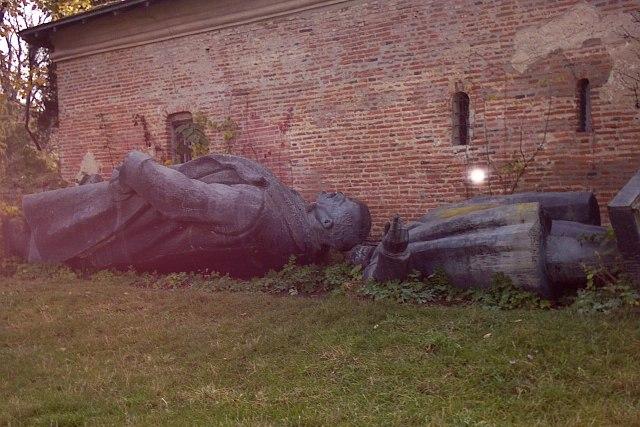
Mogosoia Palace: Lenin, toppled; elsewhere, revered


Mogosoia Palace - 1698-1702
Statue of Lenin

Lenin statue, toppled, Mogosoia Palace, near Bucharest, Romania


Mogosoia Palace is not far from Bucharest. Enjoy the grounds before heading into the traffic. It dates from the 1600's at its earliest parts. See http://www.bookcase.com/~claudia/mt/archives/000066.html

For us, the lure was the statue of Lenin, pulled off its pedestal in Bucharest and ignominiously dumped behind the kitchens here.

The complex shows Byzantine elements, and the style known as "Brancovenesc" after the Voivode, local ruler of Wallachia who built it, or as he is known more simply, Brancovan.  There are combined balconies, arcades, staircases all over, balconies Greek columns, and Renaissance and Baroque - all in one setting. See http://bucharest.8k.com/mogosoaia/  Brancovan offended the Ottoman overlord, however, and lost his head. As with Vlad Tepes, it was not uncommon to keep the head and return it without the body, as Brancovan's wife did,

The Palace became a high-level caravanserai, or "han", with space for passing caravans to enter a protected area for the night of a few days,  See the history of hans at http://www.turkeytravelplanner.com/architecture/SeljukCaravanserais.html

Mogosoia was renovated in the 1800's by an aristocratic family, then followed a series of patrons, owners, literary and cultural uses. It became a salon, and now is in a holding pattern, the lake silting over, the views muted.

Thursday, June 22, 2006

Travel Tips. Driving. Sharing the road; hints and cautions


Driving in Romania

Horse cart, Romania


1.  Sharing the road.

Expect to share it with horse carts, ox carts. The transportation for rural people in the east is animal, and animals also do the plow/farm work.

 I understand that a law now prevents the horse carts from the major roads.  How do rural poor people now get around?


Horse carts are everywhere but the high mountain passes.  Towns, cities, countryside. also in the towns and cities. Does the prohibition further marginalize the poor, without providing an alternative.

In the industrialized west, there were tractors pulling the wagons of produce and hay - it was 10 days, however, in  Romania before we moved out of the agricultural east and center, and saw a tractor.


Oxen are usually not on the major roads. We were there at harvest time, October, so the loads on wagons were huge.


Ox team wagon, Romania

2.  Driving rules

See Romanian driving rules at http://www.enzia.com/Pages/Car5.  The car of choice is the practical Dacia. See it new at http://www.daciaclub.eu/romanian_carmaker_manufacturer_dacia.php, and old everywhere else. They go with duct tape and fit a dozen people at once. The Dacians occupied Romanian land in the time of the ancient Greeks and Romans, see http://www.eliznik.org.uk/RomaniaHistory/dacia.htm.

The Roman Emperor Trajan finally conquered this powerful kingdom in about 105 AD -- that late, and after fierce warfare.  See Dacian culture at YouTube, http://www.youtube.com/watch?v=S61vFE8swUk


Check the US government info on any country where you plan to drive. For example, go to travel.state.gov/travel/cis_pa_tw/cis/cis_1004. The Romanian tourism people are also helpful. See www.romaniatourism.com/while.

Afterpost- 1/2/07 - with Romania now in the European Union, what will change? Not sure.

I saw no accidents. People are courteous, but go very fast. Just watch for everyone else on the road, on foot or with animals, and pass fast in and out yourself. Other drivers will slide over and make room, I found. There are people carrying firewood and other necessaries on their backs on the roads. We just went slow and did fine, even on back roads.

Avoid night driving. If dark comes upon you, creep. All bets are off. The horsecarts and some of the older cars do not have lights or reflectors. Fog settled in one day (very fitting - at the Hotel Castel Dracula, Transylvania, east of Bistrita at Piatra Fantanele). We stayed at the hotel, reading and chatting until noon, as did most everyone else.

Drive on the right. Drivers are on the right side of the road, and very skillful.

1.  Driving in Romania

It is easy to drive in Romania.  Their alphabet is Roman, as ours, so names are easy to read, easy to find.  Roads may end unexpectedly, so build in extra time for the turn around and finding another way.


Passing. In passing, the customs are different.
The passer tailgates. The slower vehicle immediately pulls over halfway on the burm or as far as possible. The passer whizzes out over half the center line, looks, then keeps whizzing past or pulls back in. The slower one meanwhile leaves plenty of room. The passer seldom has to go entirely into the oncoming traffic lane -- I did not see one accident caused by passing. I only saw one fenderbender in a town, a usual rearender.

Roundabouts. Most sites on driving in Romania are alarmist. Not so. Just keep going around the roundabout until you can slither off, and watch who is ahead and beside you first, then look behind.

Dogs. Watch out for the stray dogs. They are quick, but all over. Some estimates are 2,000,000. Just go slow, and keep your hands in your pockets. The situation is tragic. Dog hell, says this site : Dog hell. Horrible to read about, but if you are going there, you will see them. During a Ceaucescu relocation period when entire neighborhoods parts of great cities were being torn down and enormous public buildings put up, the government did not permit people to take their pets. So they were set loose, many survived and are all over as feral cockers and feral pekingese and everything else huge and little. No neutering program until too late. Now the government is just trying to get rid of them. Many beautiful dogs there, many sick. Many. I did not see dogs run over, though. Drivers are careful. But the news accounts say worse, things a passer-by does not see.
Tuesday, January 25, 2005

Brancusi, sculptor? - Mystery Roadside art, and Mystery Man

Totem sculpture, Brancusi-like, woods, after Baie Mare, Romania

This tall totem-type carved pole, or entire tree trunk, is located in the middle of an S curve on a road in the mountains. Workmen farther down said it was by Brancusi. Is this real, or a look-alike?  See http://www.brancusi.com. The mystery remains. For some of his work, see http://www.guggenheim.org/exhibitions/brancusi/overview.

This one was just suddenly there.


This gentleman also appeared in the middle of somebody's orchard as we drove by. Is it Brancusi?

Roadside woods sculpture, seated man, near Baia Mare, Romania

Constantin Brancusi was bearded (search images) mostly, and although he made a self-portrait, it does not resemble this at all. 

Travel tips. Packing: One to wash, one to wear, one for spare: plus:

 Travel Packing

What to take into an unknown.  In the fall, how cold will mountain areas be.  What is needed.  We took too much, but it all fit in our backpacks plus the small duffel we -- in those days -- could send through at no cost.  Fit the categories of items in plastic bags, one per type of clothing, and all in a backpack.  Then the security people can rummage more eaasily.

Looking back after a few years, see what we took, and what we did not need:  Dan, the gent, had about the same.
  • Ladies: lightweight, fast-dry; basically one of each to wash, one to wear, and one for spare.  We now, after several years, are down to one to wash and one to wear.
    • One lightweight duffel-backpack, with extra nylon empty duffel inside for overflow and to keep in the car for the seldom-wears.
    • Two synthetic poly long pants, black, tan. One belt.  One pair black jeans (Skip jeans - too heavy).
  • One black wind-rain top, with hood.
  • One fleece jacket.  Skip that.  Use the sweaters.
  • Two synthetic turtlenecks, black and gray.  One would do, but I liked a change.
  • Two cashmere pullovers, black and gray. Keep the two, if you do without a fleece.
  • Two short sleeve synthetic T-shirts, red and black.  Ok.
  • One pair hiking boots.  Skip that.
  • One pair black walking shoes, slip-ons, no laces.  Keep it simple.
  • One pair lightweight black flats - a must.  Double as slippers, eating out.  Keep those.
  • One longish skirt (splurge on Patagonia, and this is not a paid site but they do a good job)
    • long-ish, in case Orthodox monasteries require that ladies not remind men that women also have two appendages, called legs
    • a skirt like this was needed in Greece, where they forced a long hip shawl on you ifa you came in pants, but not in Romania after all.  
    • The skirt still was nice for pretend dress-up for dinner once in a while.
  • One wool watch cap. We could skip that. Pull up your hood and endure.
  • One pair gloves.  Skip
  • Three pairs socks; one pair knee-hose. Two is enough. Wash and wear.
  • Three pairs underwear, tops and bots.  Two pair of underpants and two bras will do.  Dry them on the back seat.
  • One lightweight robe, for trekking to bath.  Not needed. Take instead a substantial T-shirt dress, sleep in it, lounge in it, have a belt, and sashay down the hall fully dressed.  I have a black heavy T-shirt dress now.  Can go to dinner in it. No dedicated nightgown at all.
Beauty. What?
  • Minimal jams and jellies. Yes.  Your gorgeousness will survive two weeks of deprivation.  Does anyone else care if you have liver spots?  No.