Tuesday, May 08, 2012

Transfagarasan Pass - Hike. Carpathian Alps - Route from Wallachia to Transylvania

Transfagarasan Pass
Carpathian Mountains


Carpathian Mountains, Transfagarasan Pass, Romania

1.  Blasting open the Pass

The Fagaras Mountains, are part of the Carpathian Range.  Wallachia is on one side. Vlad III Tepes was Wallachian.  Transylvania is on the other.

At the northern end of the pass are the cities of Sighisoara, the birthplace of Vlad III Tepes, and Sibiu; entry to the painted monastery areas, and much more.
There is a history of hardship and labor deaths here, from blasting a way across and through a tunnel, for vehicles. See http://www.expeditionplus.com/2006/07/the_fagaras_mountains_and_the_1.

The Pass was built as a way to move troops and ammunition to defend against a feared Soviet invasion in 1968. The Transfagarasan Pass, through and over the Transfagarasan Mountains, is more easily remembered by the name of the town at the north side, Fagaras. See http://www.transylvania-discovery-tours.ro/en/top/daily-tours-in-transylvania/land-of-fagaras-day-tour/

2. Accessibility

The Pass in these mountains is open as weather and season permit. This was the end of October - lovely for leaves, views, but beginning risky for weather.  With snow the tunnels and high switchbacks are closed.  Check at Curtea de Arges before launching out in this direction.  There will be a sign, not big, affirming whether the pass is open. On maps, the road will look as though it stops.  Instead, that open bracket symbol means tunnels.

Cabanas is the magic word. There are hotel-type places for sleeping, called Cabanas. Are they government-run? Not sure.  Just don't let it get dark on you. Stop in time. For an overview of the mountains in Romania, see "Romania's Road to Heaven," at http://www.escapeartist.com/efam/68/Living_In_Romania.

On the way, we knew there would be "cabanas" or small hotels, but did not expect the distances between. Don't wait too long in the day to stop. You need all the visibility you can get - not all vehicles have good headlights, and animals may wander in the road. We were just about to turn back, when one appeared. Do not expect signs to tell you when the next will emerge.

3.  Stop the car, park and trust, and hike.


Transfagarasan Pass, midday hike, Romania

Stop along the way and take a hike. If you are a worrier about leaving the car, you will miss out. We never had a problem. Look closely:  There is half of the Car-Dan Tour Company, snapped by the other half, as we crossed a boulder-strewn creek bed with no particular destination in mind.
The car was indeed there when we returned.


Other attractions: See http://www.expeditionplus.com/2006/07/the_fagaras_mountains_and_the_1.


Wednesday, April 11, 2012

Sibiu: Naver or Tradesmen; Saxons of Transylvania

Saxons of Transylvania 

Naver, tradesmen, Sibiu, Romania

Sibiu, Romania. We had believed these men to be Roma, but now learn that the dress is that of traveling tradesmen, or "naver".  There are many Roma, of rank and ethnicity from the poorest, to well-to-do.  There is a casino in Sibiu that drew many with means, and in elegant dress.

1.  The Naver are of Saxon heritage.  This group is common mainly in the north central parts of Romania. They have a long tradition of education and skill. Traveling tradesmen, with knowledge seen by outsiders as secret, and with connections to Teutonic Knights.

This relationship, to Germany, relates back to at least.. The Old Holy Roman Empire where the boundary between Slavic and Germanic lands held for centuries, but with flexibility, blending and fighting.

In Romania, German peoples were invited in during the medieval era, to help with mining and agriculture in Slavic lands, and then stayed, see http://www.galiziengermandescendants.org/Data/History2.pdf.  A Germanic tradition here in Sibiu is just a part of the larger Germanic culture in Romania. There are the German - Saxon walled churches located in the region.

2.  Relationship of Naver to Teutonic Knights. Occupation, skillsets. The Teutonic Knights were a medieval monastic military order that fought in the crusades, see http://www.britannica.com/EBchecked/topic/586765/Templar

A search for Naver - a quick one - shows more information about the tradesmen and Templar influence.
The Templars were not only fighters and guardians of travelers and pilgrims, and highly successful bankers holding scrip and property until the bearer might or might not return to claim his property; but also keepers, the tales tell, of mysteries taken from the Holy Land. Now we learn that the Templars were also part of an information/skills network between the East and to the West; that the Templars brought building skills and implements to the West, giving rise to the Masonic tradition and its symbols. And the Naver arose from that tradition. And that those connections enabled the building of the ever-more elaborate Gothic cathedrals. More info see http://www.curezone.com/blogs/m.asp?f=665&i=2/.

Sunday, April 08, 2012

Sighisoara, Vlad Tepes Birthplace; World Heritage site


Sighisoara: Birthplace of Vlad Tepes
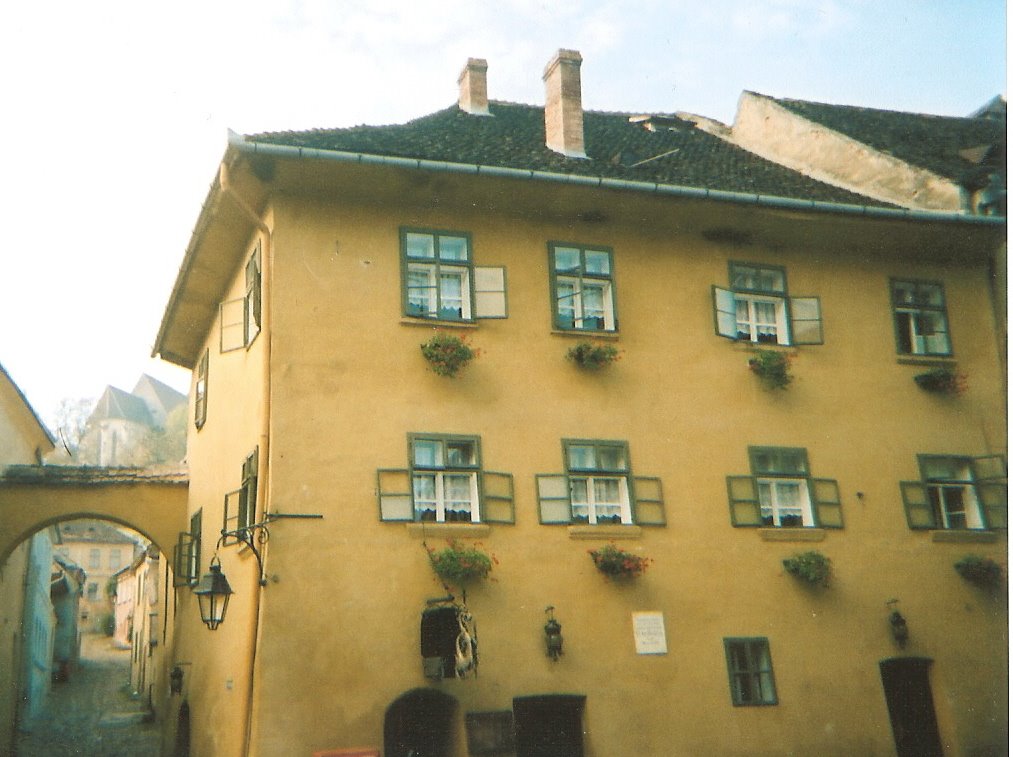
Vlad's family home is now a Restaurant

Sighisoara, birthplace of Vlad Tepes, Romania
Sighisoara was established by the Saxons of Transylvania.

1.  Birthplace: The big yellow house.

The home where Vlad Tepes was born in 1431 is now a restaurant. Expect and get generous portions of good basic food. Sauces and frills are few, so the atmosphere seems authentically Romanian.

The town is in excellent medieval condition, never bombed, or overrun. See the photo gallery at http://www.world66.com/europe/romania/sighisoara/lib/gallery.Although he ruled Wallachia for periods in a brief timespan, 1456-1462, his reputation suggests a far longer domination.

2.  Monuments and The Novel, Dracula.

There are references to Vlad Dracula in many places, and they often refer to the novel, Dracula, by Bram Stoker, even though it is far removed from the life.  Reread the Stoker novel at Dracula, http://www.literature.org/authors/stoker-bram/dracula/

As in other Romanian cities with ties to Vlad Tepes, there are excellent descriptive plaques in Sishisoara. They separate out the kitsch, and offer historical information particularly where Bram Stoker made other fictional claims. The result is to interest people who want to know what really is known, or reasonably so; as well as those who want to follow in Bram Stoker's characters' steps without critique.

Entire tours are devoted to Vlad, but the distances between real sites is great, and there is too much to see in between to focus only on Vlad.. The Romanian Tourist Bureau provides an overview of his life as told in legend. See http://www.draculascastle.com/html/poenari.

3.  World Heritage

Sighisoara is a World Heritage site. See http://www.romanianvoice.com/images/orase/sighisoara.php. The full list of places on the Romanian World Heritage honor roll is at http://www.thesalmons.org/lynn/wh-romania. Fine photos: at this Unesco site --  http://whc.unesco.org/en/list/902


Friday, November 11, 2011

History and Culture. Romanian History and Haplogroups. Dacians and Danes.

Haplogroups. Genetic identity, and common ancestry. 

Populations can now be tracked as to their earlier migrations thanks to haplogrouping.  Romania, with its proud history of Dacians dating back to Roman times, and now perhaps earlier, can claim a new connection to Dacians in Denmark.  First, as to haplogroups, see http://www.scs.illinois.edu/~mcdonald/WorldHaplogroupsMaps.pdf/  Second, Romanian history and haplogrouping, this particular page focusing in Vlachs, at http://romanianhistoryandculture.webs.com/howmanywallachias.htm/

Romania:  The name derives from the Latin (Roman), with its influence in the north, Greek influence in the south.  There were migrations to Europe, the Danube.  Migrations back to Iran, Indo-Asia.

Now:  With strong northern European connections to Middle Eastern haplogroups, and a migratory path through Romania, the Caucasus, who can track, or is there a connection, between the Middle Eastern haplogroups and the Jewish.

 Is there an identifiable haplogroup, for example, for the tribes of Israel. Looking at the World Haplogroups site, above, I see none specifically for Jewish persons in the Middle East. Biblically, is that few of the 12 tribes can be tracked.  Others are lost. However, efforts are ongoing to identify by a Jewish haplogroup, see http://www.jewishgen.org/dna/genbygen.html/  A more cautious note is laid out in a more scholarly way at  http://www.jewishvirtuallibrary.org/jsource/judaica/ejud_0002_0007_0_07174.html

Speculate responsibly about the lost Israelite Tribe of Dan, for example, and the origin of the Danes, and that migratory path, see http://denmarkroadways.blogspot.com/2011/08/origin-of-danes-danmark-dan-etymologies.html/ 


Monday, October 10, 2011

Saxon Villages. roadway oxcarts, current events: Siebenburgen, Transylvania


2012 Update for a lovely area. 
 Tradition protected; while seeking more than sustenance.

This area of Saxon villages in central Romania is increasingly a destination point.  The Mihai Eminescu Trust, as well as the Charitable Foundation set up by the Prince of Wales, have been revitalized, supported.  The settlements began in the 11th Century, and the way of life is difficult there, and has been since about 1240. It is at the crossroads of invaders from several directions:  Mongol from the East, Ottoman from the South, and Hungarian from right next door; add other Romanians, and the Plague.

When we were there, the agricultural methods in use look nostalgic, but were backbreaking. 


The bucolic, with slow oxcarts laden with hay, cows following a leader (human or bovine) down the village street, peeling off to houses in the lane, are deceptive.  This is subsistence living. Mechanized ways were not prevalent in this section of eastern Romania. The west is more mechanized, with tractors. Romanian history:  An Australian tour site gives a comprehensive look -- see http://www.asatours.com.au/21313/1536-21313-romania-revealed-overview -- Asatours, Australia, on Romania.
.
Saxon areas:  After WWII, Saxon adults (as German heritage) were largely sentenced to hard labor and deported to the Soviet Union.  Only about half survived to return.  The country by then was communist. See Financial Times June 16-17, 2012 at p.2. In 1990, they were invited to return, upon Nicolai Ceausescu's removal as President.


Thursday, October 06, 2011

Culture. Horsecarts now banned, major roadways. Near Sighisoara.

Sighisoara Area Walled villages. Saxon? 


Horsecarts, wagons with auto wheels, are built with divided supports for flexibility front to back, and can carry whole families on board, goods, equipment. They are also on all the roads, including major highways, until we now read that they are banned from major roadways.

We never saw any accidents, even on the motorways.  The carts kept well to the side. There were only courteous drivers slowing up, going around, blinking lights if a cart happened to be in front, and that was the reason for the slow-up. So many of them - on main highways, everywhere. A rule for us was never drive after dark if we could help it - many carts had no reflectors, and no lights. In foggy areas, we crept.

There was a massive road-building program in progress, however. We were there in the fall, also, and that meant end-of-summer pothole filling in preparation for another winter. The best time to travel in Romania then was in the fall. Spring meant the new holes gaping out there, and worst for the horses. So, European Union aspirations mean big bucks for some, and a hindrance to an already marginal life for so many poor.

See the issue of those who prosper from their investments and properties, at the expense, again, of the peasant (andthe gypsy) who cannot get to their destinations in many cases, except by the major roads.  See  http://query.nytimes.com/gst/fullpage.html?res=9D06E1DA1630F931A35752C1A961958260&sec=&spon=&pagewanted=all

Horsecarts are now banned from major roadways. The funding is for the roads for the rich, and to draw in tourists;  not for the poor areas at this point: http://www.gadling.com/2007/11/20/the-death-of-an-anachronism-horse-carts-banned-from-romanian-ro/

Wednesday, October 05, 2011

Saxon Fortified Churches - Sibiu-Sighisoara area; World Heritage

Saxon Romania.  The road from Sibiu to Sighisoara extends through lands known as the Saxon region, south of Targu Mures. It consists of some 200 villages in an area about the size of Belgium, estimates the Financial Times in its article, A stake in Transylvania, 3/18/2012, see http://www.ft.com/intl/cms/s/2/827b9c84-69d5-11e1-8996-00144feabdc0.html#axzz1qjfc93rb
.

Targu Mures, walled Saxon Churches, Transylvania, Romania


These walled Saxon churches are World Heritage sites. See http://www.cimec.ro/Monumente/Lpm/UNESCO/Biertan/eng. The old German script is still over the door. There were substantial migrations of Germanic people into Romania beginning in 1123, by invitation of the Hungarian King Geza, and during the centuries.
.
The new groups kept their own language, and protected themselves with walls like these around towns and churches in the 15th-16th centuries. See http://www.archaeology-romania.org/projects/fortified-saxon-churches. We were told that funds are coming in again, from Germany, and from the descendants of those expelled by wars and other invasions. People also moving back.

There is a map for them at http://www.cimec.ro/Monumente/unesco/UNESCOen/indexTrans.
.
These church walls, seen from the inside, have rooms in them for entire families. We were told that if a couple wanted a divorce, they would be put together in one of these rooms for 60 days, be fed and taken care of, and as a result, they seem to work it all out and no divorces were recorded there. Most of these churches are between Sibiu and Sighisoara. Here is a fine photo of a walled church: http://www.roconsulboston.com/Pages/InfoPages/Travel/DealulFrumos.
.
More specific ethnic-cultural roots:

Other sites say these were Swabians, from the Danube area in Germany - see the Schwabisch Hall post at Germany Road Ways; and that would place them from the Augsburg area, see http://www.mpip-mainz.mpg.de/~pleiner/schwabhist.html.  Saxons were from farther north, but it appears that the Hungarians specifically felt an affinity for the Swabians, but the Saxons also came.  Their own old mythologies refer to the migrations, see http://www.urbanmyths.ca/Myths/The-Saxon-And-Swabian-Migration-.html

Village women, near a Catholic Church, near Targu Mures, Romania
.
Label this episode: To the outhouse.
.
This picture is not of an outhouse, but we had been going back into villages off the road to try to find our own walled churches.  The DK book is not detailed enough. We came to one lovely church - and it turned out to be a Catholic one, not German - and these ladies kept gesturing to the outside and indicating, come on.
.
So we did, through mud, over yards, around puddles, through gates and gardens, all winding through the village until we came somewhere and they gestured us over with great ceremony.

The ultimate destination was indeed an outhouse. Very hospitable. Where else would fine local folk invite tourists to their outhouse? We didn't need it, but appreciated the thought and saw parts of a Romanian village no bus tour could match. Thank you.
.
There are many Roma, or gypsies, in Romania.  They were brought in as slaves and as a group have not been allowed to advance.  The cultures do not mix. See Gypsies, Roma, Romani.   This is not yet a fully automobile society, and rural areas are served by horse carts.  My understanding is that most of those belong to the Roma, not the other ethnic peasants.  We didn't see a motorized tractor for 10 days.
.
Horses and carts are also in the cities and the highways. The construction of the carts is ingenious, with a break in the axel (what is that connector not between wheels laterally, but going the length of the wagon to accommodate the huge potholes and ruts? Car tires are used.

This horse cart was outside the walls of a rural village, but not the Saxon walled church village.
Roma horsecart, near Targu Mures, Romania

Friday, September 30, 2011

Accommodations: Prince Charles in Romania. Saxon areas, Transylvania. Guesthouses; Other Projects

Projects in Conservation, Guesthuoses, Education, Trusts and Charities
International Benefactors
 
Preserving, Conserving Old Ways
By Accommodating the New

Saxons in Transylvania
Old villages; historical renovation sponsored by accommodations
Update on international benefactors:  Even the Financial Times recognizes the efforts by Prince Charles, through his trust, and others to preserve the heritage of Romania, here the Saxon: at Romania property, a stake in Transylvania, at http://www.ft.com/intl/cms/s/2/827b9c84-69d5-11e1-8996-00144feabdc0.html#axzz1qjfc93rb.  Read that entire article, by Teresa Levonian Cole 3/17/2012.  The history of Saxon migration into Romania, at the invitation of a medieval Hungarian king, growth to some 200 Saxon villages, then World Wars, expulsions, and now interest back again.
.
1.  Housing:  Citizen and Visitor
.
Prince Charles of England has made and is making a substantial difference, in Transylvania in particula.  He promotes and otherwise sponsors saving old houses, conservation, encouraging visitors with planned guesthouses at intervals, and training villagers in traditional building methods that use local materials.
.
He has bought "endangered" properties and is turning them into guesthouses, or showing local people how to do it. 
.
William Blacker wrote Fit for a Prince, The Financial Times, August 28-29, 2010, at page 8, Life and Arts.  See http://www.ft.com/intl/cms/s/2/6cabf0fa-b169-11df-b899-00144feabdc0.html#axzz1US4nTH7D.  This is a well-written description of Romania.

Look up also the
These organizations foster "traditional craftsmanship" as well as how to succeed at small-scale farming, and raise money in many ways that attract non-builders..
.
Prince Charles - Royal Highness, Prince of Wales, with a worthy set of projects here, rescuing traditional properties, morphing them into guesthouses; sponsoring education, skills.
.
We found the small hotels along the way, well-spaced for the traveler,"cabanas" or pensiones, to be just fine.  We found them clean and warm.  No complaints about any of the accommodations we found in Romania, but choice is nice.
.
Many little hotels were threadbare.  Inside the duvets were blankets, heavily felted, but with holes. Nonetheless all bedding was spotlessly clean.  We never minded threadbare in felted blankets, or sheets. We never questioned the cleanliness. Bricks, tiles from terracotta techniques.
.
Villages we missed, but you could see: Visceri, Zalanpatak (Hungarian:  a Romanian friend told us that the old people in her family would say, Hun-GAR and spit. Those times, we understand, have passed. Hungarian and Romanian history are intertwined, although village animosities remain. The Prince owns his own house in Romania, address not given.  Smart.  It is said to be modest, delightful.
.
2.  Welcome to preserving.
.
The Prince is not against modern development, but wants it to proceed alongside the preserved original, where the original is also now productive.  It is too late in many places. Whole villages were destroyed even after Premier Ceausescu was executed in 1989, along with his pattern of bulldoze it now, think later. The bulldozing did not stop. Was this mainly for Roma villages, or other peasant? Or did it matter?
.
Euros pouring in do not help in conservation of culture.  Euros just find pockets, as dollars do here -- it all does not get to the purpose intended. The article correctly states that the replacement block building for mass residences are hideous.
.
I am tempted to reproduce here all our (to us) wonderful rural photographs, people, costumes, ox carts.  What about the gypsy village where we stopped to ask directions for a night's lodgings, got a fine deli sausage sandwich and an orange soda.  To take pictures seemed intrusive, so we did not. Now I wish we had.  Will others see the same hospitality, open welcome.
.
Prince Charles of England. Good work. Tell Wills. Tell Harry. Welcome to Romania.  Carry on. Sally forth.  Even ordinary people want to see your fostering of traditional talents and lifestyle and architecture, remain.  Salute. Prince Charles fosters Romanian guesthouses.  Yes. More. Cultural conservation in Romania. Cultural trusts.  High time. Go there.

Tuesday, September 20, 2011

Bistrita, Piatra Fontanele and Hotel Castel Dracula: Bram Stoker's Dracula Story

 Bistrita
Bram Stoker's "Dracula"

Bistrita is the town located near the area where the "Dracula" author, Bram Stoker, located his fictitious Dracula's castle.

His character, Jonathan Harker dined at the Golden Crown here.  Bram Stokerwas born in Dublin -  see http://www.online-literature.com/stoker/. This is the Literature Network site.

1.  Weekend slowdown.

On weekends in Bistrita and other towns, things do close down, so don't plan for museums or sites after lunch and especially on Sundays. Find an overview of the town at http://www.museum.ici.ro/transilvania/bistrita-nasaud/english/istoria%20oras.

A walk around was all we wanted.

2. Hotel Castel Dracula

It was time for kitsch, so we stayed here.  The good news is that the kitsch is restrained, and localized. The rest of the accommodation is a fine hotel, although in need of some repair. 

Hotel Castel Dracula, near Bistrita, Romania

Hotel Castel Dracula is to the east, past Bistrita, and supposedly at the place where the fictitious castle in the novel, Dracula, was supposed to be located.


3.  Kitsch

The hotel has a secret passageway and room, that you have to search for yourself and then - gasp - it is there. The Coffin. And cape for dressing up.


Dan Widing locates The Coffin, Hotel Castel Dracula, Romania


Other than that, it is a full-service, comfortable hotel: good food, books for sale in the lobby, much research on the Stoker's Dracula-Vlad comparison.

Wish for a foggy morning so that driving is risky. The horsecarts are a hazard despite reflectors.

Then you will have to stay a few hours longer, and curl up with a good book.

4.  Hiking Center

The hotel has been discovered by serious hikers. It is near a wilderness park, with Big Animals (real wolves and bears), and the trails look great.

5.  Games

There is also a pool table and pub up the tower. For enviro-tourists, despite the touristy name Castel Dracula, stay here as your base for side hikes. Any big facility needs upkeep, and they are working on it.

Other accommodations:

6.  Warmth

We had no difficulty with cold nights.

Usually we stayed at any family pensione, or a "cabana" in outlying areas. A cabana is like a villa, small hotel-hostel-pensiones for travelers, at well-spaced intervals in mountain or recreation areas. All clean, safe, warm, with thin compact mattresses, but plenty of felted blankets in the duvets. The felted blankets, think heavy, tight wool blankets, soaked and dried several times to tighten it up and make the felt, very thick - not like hats. We sometimes put the additional duvet underneath.

Tuesday, August 09, 2011

Romanian Food

 Time to Eat
But what? Not to worry.

1.  Staples

Cornmeal.  Food is excellent in Romania; hearty, with a great deal of cornmeal, as in mamaliga, a cornmeal mush (like polenta, formed and unformed) with or without other vegetables, cheeses.  See http://www.food.com/recipe/mamaliga-cu-branza-cornmeal-mush-with-cheese-122683

See also cornmeal porridges (that that mamaglia, served like a mellow and rich polenta), soups -- especially ciorba, a sour soup. Recipe at http://www.natashascafe.com/html/ciorba.html
Hearty. It is not a spicy cuisine. See overview at http://www.romaniatourism.com/foodwine.

2.  Root vegetables, regular barnyard meats.

Overall, think home cooking.  Root vegetables and potatoes, cabbage dishes, chicken and lamb and beef stews, sausages, cutlets, 

Breads are whiter than we expected, but there is plenty of it.